By Jonathan Seal · Research-led guidance · Updated
As an Amazon Associate I earn from qualifying purchases. About our affiliate links.
The short answer
Fold it and take it inside whenever you can. That's the one big security advantage a folding bike has over a regular one, and no lock beats it.
When you do have to leave it, lock the frame (not just a wheel) to something solid, in a busy, well-lit spot, with a good U-lock or folding lock pulled tight. For longer stops, add a second lock of a different type. Take anything that comes off easily, and write down the frame number before you ever need it.
We haven't tested these locks ourselves. The advice here comes from Tern's theft-prevention guide, Sheldon Brown's lock strategy, New York City's law and the lock makers' own ratings, read on November 19, 2026.
Take it with you
Tern's advice for long stops and overnight is simple: indoors is always better. It lists a garage, a bike room, a cage, or a corner of your apartment or office. A folded bike fits under a desk, beside a table at a cafe, or in a hallway closet, places a regular bike can't go.
Every big US transit system we checked lets a folded bike on board too, so the bike can stay with you for the whole trip. Our transit guide has the rules for the big US systems.
Where to keep it at work
Ask your office manager or building management first, and ask about the folded bike specifically. A building that turns away full-size bikes may be fine with one that folds small.
In New York City, the law is on your side. Under a 2016 city law (Local Law 105), the owner of an office building can't bar a tenant from taking a fully folded bike to and from its space in a passenger elevator. The law defines a folding bike as one that folds within 20 x 36 x 32 inches. On paper, a Brompton (23 x 22.2 x 10.6 inches), ZiZZO's 20-inch bikes (31 x 13 x 27) and Tern's Link D8 (31.1 x 28.3 x 15) fit that box. Tern's 24-inch Node D8 (33.9 x 33.1 x 15.4) doesn't.
The city's older Bikes in Buildings law covers full-size bikes too. Office tenants in buildings with a freight elevator can ask the owner for bike access, and the owner has 30 days to set up a bike access plan or file for an exception. The tenant has to store the bikes in its own space.
Outside New York, rules vary by city and by building, so ask. Once it's inside, keep the folded bike out of walkways and fire exits.
When you have to leave it outside
Pick the spot before the lock. Tern's rule is safety over convenience: open, well-lit places with steady foot traffic and shop fronts nearby, ideally where you can see the bike. It points out that most bike theft is opportunistic, with thieves scanning for the easiest target, so a few deliberate choices make a real difference.
Lock to something that can't be cut, unbolted or lifted. Tern suggests a well-anchored rack or a thick metal post, not decorative street furniture. Sheldon Brown adds two checks: make sure the post can't be lifted out of the ground with the bike still on it, and that locking there is legal, since bikes left in the wrong place can be removed.
Don't leave a folding bike locked outside overnight if you can avoid it. If you have to park outside every day, Tern suggests varying the spot from day to day.
Lock the frame, and fill the lock
Wheels come off quickly and quietly, so the frame is what has to be anchored. Tern calls leaving the frame unanchored a common locking mistake.
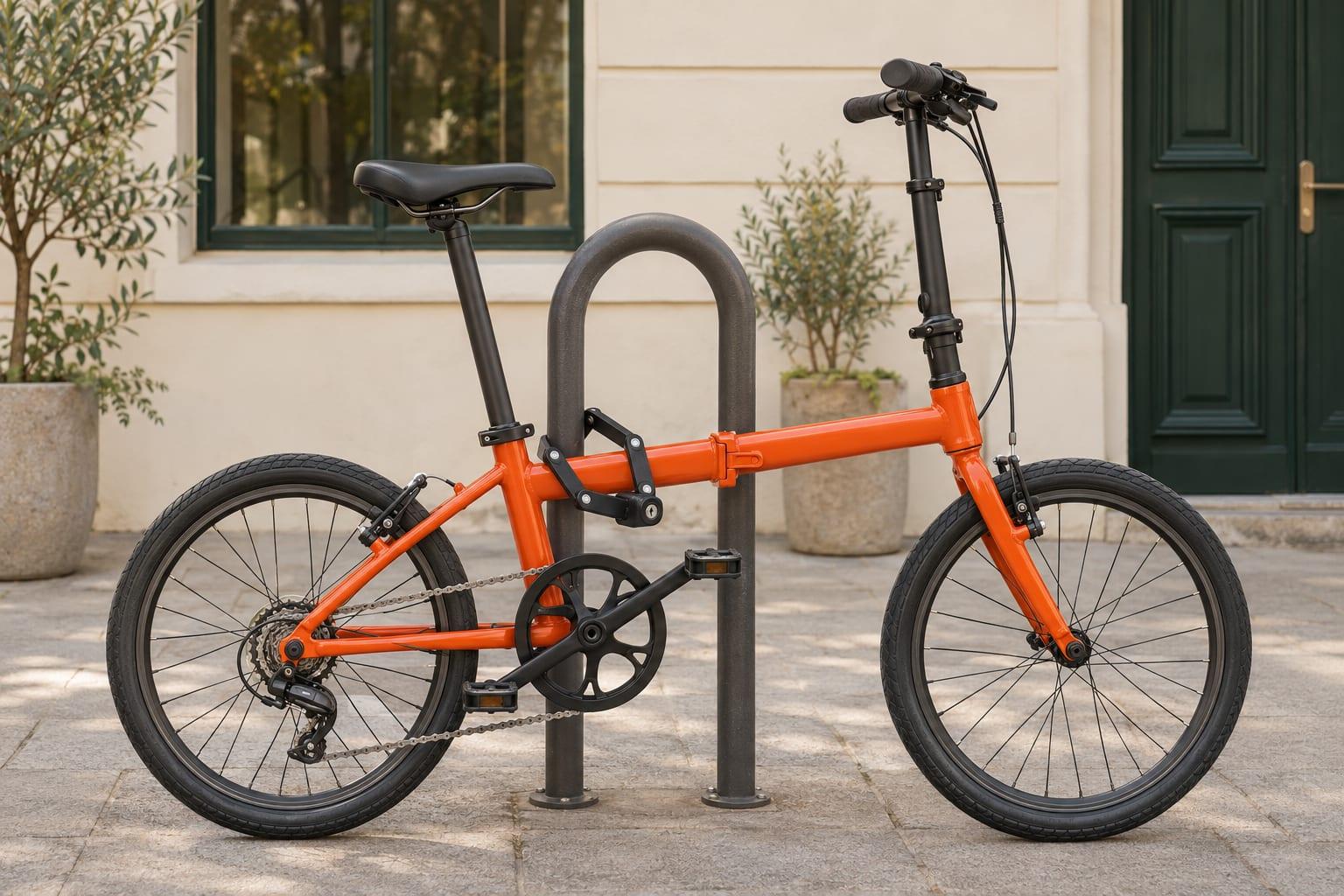
Folding bikes need a little extra care here. Sheldon Brown points out that some folders have separable seat stays, so a lock around the rear wheel won't hold the frame. Pass the lock through a solid part of the main frame that can't come apart, and keep it clear of the hinge and its lever.
Then make the lock tight. Tern says to position each lock so it fills as much of the space as possible, leaving tools less room to work. Sheldon Brown makes the same case for small U-locks: less room inside for a jack and less leverage for a pry bar. He also suggests turning the keyhole to face down, so it's harder to drill.
Which lock suits a folding bike
A U-lock is the usual first choice, and a small one is harder to attack, for the reasons above. A folding lock is the other good fit for a folder. Its steel bars fold into a short block, so it's easier to carry than a long chain and still reaches around a rack and the frame. Tern pairs a U-lock with a heavy-duty chain for valuable bikes, though a chain is a lot to carry on a folder.
Cable locks are for quick stops only. Sheldon Brown notes that a cable is easily cut with bolt cutters, the tool most bike thieves carry. A cable earns its place as a second lock, holding the front wheel while a U-lock holds the frame and rear wheel.
For anything more than a short stop, use two different types of lock. Both Tern and Sheldon Brown make the point: each type takes a different tool to defeat, so a thief has to bring and use both.
Ratings help you compare. Tern points to Sold Secure Gold and Diamond (UK) and ART-3 and ART-4 (Netherlands), which come from independent lab tests that include grinders. ABUS rates its own locks on a 15-level scale.
Brompton also sells a Cafe Lock, a combination lock built into an extended seatpost. Brompton itself calls it low-security, for deterring a passing thief while you're nearby, like on a train or at a cafe. It's not the lock to leave a bike with.
ABUS Bordo 6000K/90 folding lock. 5 mm hardened steel bars, ABUS security level 10 out of 15 (its rating for medium theft risk), 90 cm long when opened and about 1.2 kg. The 120 cm version reaches more, but weighs more to carry.
View on Amazon ↗
Take or secure the easy parts
Anything that comes off without tools can walk away: bags, baskets, lights, and wheels or a seatpost with quick-release levers. Sheldon Brown recommends swapping quick releases for locking skewers that need a special key, and Tern names Hexlox and Pinhead as options for parts you'd rather leave on the bike.
On a folding e-bike, take the battery, and the display if it comes off. Tern calls removing the battery one of the simplest and most effective habits, since it's often the most expensive part and a bike without it is far less tempting. Tern treats app locks and GPS trackers as an extra layer on top of good locks, not a substitute for them.
Record it before you need to
Write down the frame number and keep it somewhere other than the bike. Tern also suggests registering the bike with a registry such as Bike Index, which keeps a searchable public record that makes a stolen bike harder to sell, and taking clear photos of it, including one of you with the bike.
Then check your home or renter's insurance. Tern notes that adding a bike to an existing policy may be simpler than you'd think, or a dedicated bike policy may suit you better.
Common questions
Short answers to what folding bike owners ask most about locks and theft.
What's the best lock for a folding bike?
A U-lock or a folding lock, used on the frame and pulled tight. A folding lock packs smaller for carrying. For long stops, add a second lock of a different type, and look for independent ratings such as Sold Secure Gold or ART-3 and above.
Can I take my folding bike into the office?
Often, yes, but ask first. In New York City, office building owners can't bar tenants from bringing a fully folded bike up in a passenger elevator, as long as it folds within 20 x 36 x 32 inches.
Is a cable lock enough?
Only for quick stops where you can see the bike. Cables are easily cut with bolt cutters. Use one as a second lock for the front wheel, alongside a U-lock or folding lock on the frame.
Should I lock the wheel or the frame?
The frame, every time. Wheels come off quickly. On a folding bike, lock through a solid part of the main frame that can't separate, not just the rear wheel.
How do I lock a Brompton?
Fold it and take it in whenever you can, since it's small enough for a cafe or an office. If you must leave it, lock the main frame to something solid with a proper lock. Brompton's own Cafe Lock is low-security, for when you're nearby.
How we researched this guide
We read Tern's theft-prevention guide (updated November 5, 2026), Sheldon Brown's lock strategy, New York City Council's Local Law 105 of 2016 and NYC311's page on bikes in office buildings, Brompton's Cafe Lock page and the ABUS Bordo 6000K/90 listing on November 19, 2026. Folded sizes are the makers' own, as cited in our size guide. We haven't tested these locks.