By Jonathan Seal · Research-led guidance · Updated
As an Amazon Associate I earn from qualifying purchases. About our affiliate links.
Start with what your rides need
A folding bike solves a space problem, and the wrong accessories can bring the bulk straight back. Start with what your route, weather and storage actually require, then add conveniences once a few weeks of riding show you what’s missing.
Before you buy anything, check three things: where it mounts, what it touches as the bike folds, and whether it makes the folded bike bigger. A light or bag that sits fine while you ride can jam a hinge or stop the halves from meeting.
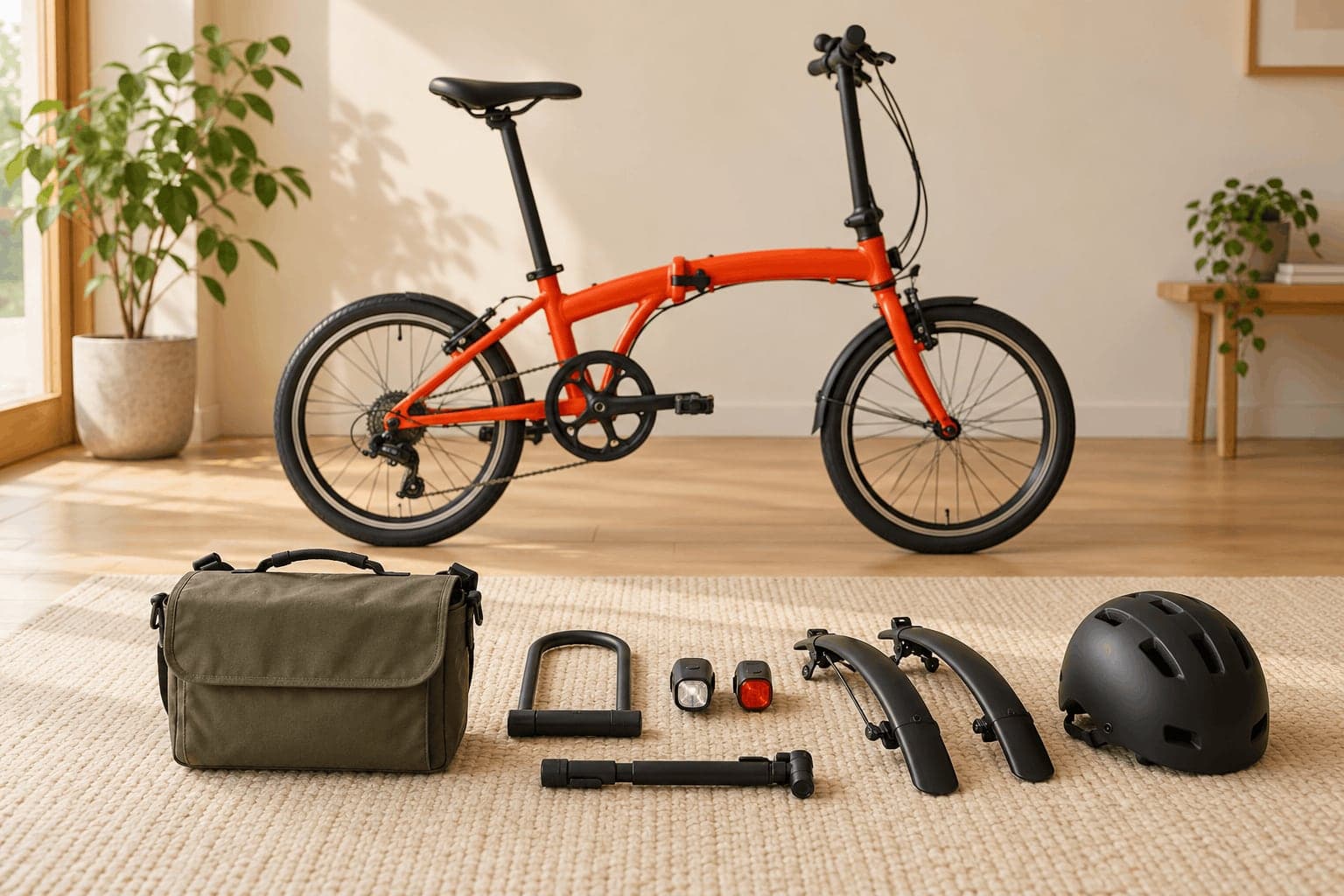
Check what your bike already has, too. On the bikes we cover, the ZiZZO Via and Forté and the DAHON Dream D6 are pictured with mudguards, and the ZiZZO Campo, Via and Liberté Plus and the Dream D6 are listed with folding pedals. The picks below are research-based: we chose them from the makers’ specifications and listing details, not from hands-on testing.
Lights: mount them where the fold leaves them alone
Lights are the first thing to add if you ride after dark or in bad weather, and folding bikes need a little more thought about where they go. Most folders fold the handlebar down beside the front wheel, so check that a bar-mounted headlight clears the tire when the stem is folded. At the back, the seatpost usually drops right down into the frame when you fold, which can push a seatpost light into the rack or the ground. Mount it high enough to clear, put it on the rack if the rack has a light mount, or unclip it before you fold.
Check the lighting rules where you ride, and charge rechargeable lights on a routine so they don’t die halfway home.
Cygolite Metro series headlight. A USB-rechargeable front light on a hard handlebar mount. The 800-lumen version in this listing weighs about 140 grams and has a daytime flash mode and a low setting.
View on Amazon ↗Cygolite Hotshot taillight. A small USB-rechargeable rear light with night and daytime flash modes and an IP64 water-resistance rating. Its small size helps on a folding bike, where little of the seatpost shows.
View on Amazon ↗
A lock that suits a folder
The best security for a folding bike is bringing it inside with you, which is the point of owning one. For the times you can’t, a folding lock suits these bikes well: it packs down into a short block, it’s easier to carry than a long chain, and it reaches around a rack and the frame.
Wherever the lock’s holder goes, keep it clear of the frame hinge and the folding path. Lock the frame, not just a wheel, and remember that quick-release wheels and seatposts can walk away on their own. No lock is a guarantee, so for long stops in high-theft areas, a heavier U-lock or keeping the bike indoors is the safer plan.
ABUS Bordo 6000K/90 folding lock. 5 mm hardened steel bars, ABUS security level 10 out of 15 (its rating for medium theft risk), 90 cm long when opened and about 1.2 kg. The 120 cm version reaches more, but weighs more to carry.
View on Amazon ↗
Folding pedals, if your bike lacks them
Pedals stick out further than anything else on a folded bike. Tern’s folding guide notes that folding or removing the pedals gives a smaller package, and on a 20-inch folder that can be the difference between fitting under a desk and not.
Many folders include folding pedals already, so check before you buy. If yours don’t, match the thread: most adult bikes use 9/16-inch pedal threads, while some budget and kids’ bikes use 1/2-inch. Fit the left pedal with its reverse thread, and if you’re unsure, a bike shop can swap pedals in a few minutes.
MKS FD-7 folding pedals. Made in Japan, with a light alloy body, a platform you can use either way up and built-in reflectors. The listing gives 428 g for the pair. Stock on this listing was low when we checked, so it may show as unavailable.
View on Amazon ↗
A pump and a spare tube in the right size
Small wheels make two things matter more. Small tires hold less air, so a slow leak or a week of sitting shows up sooner, and many run at higher pressures, so a pump with a gauge is worth having. And 20-inch and 16-inch tubes aren’t stocked at every shop, so carry a spare in your exact size. The size is printed on the tire sidewall, along with its pressure range.
Check which valve your tubes use before buying a pump. A repair kit only helps if you can use it, so practice removing the wheel at home once, especially on a bike with an internal hub or a hub motor.
Topeak Road Morph G mini pump. Fits Presta, Schrader and Dunlop valves without adapters, has an in-line gauge to 140 psi, and turns into a small floor pump with its fold-out foot pad and hose. About 220 grams, with a frame bracket.
View on Amazon ↗
A carry bag: measure the folded bike first
A carry bag covers the chain and tires on trains, in cars and in offices, and some transit operators require a covered bike. Measure your bike folded, with the accessories you’ll leave on it, before choosing a bag. Bars, pedals, racks and lights can catch on a bag even when the frame itself fits.
The bag we picked is a good example of why. It’s sized for 14-inch and most 20-inch folders, but ZiZZO’s listings give the folded bikes as 31 x 12.5 x 27 inches, a little wider and taller than the bag. Check the numbers for your own bike, and check the bag’s opening and strap too.
CamGo 20-inch folding bike bag. Water-resistant nylon, 31.5 x 11.8 x 25.6 inches, about 8 oz, with a shoulder strap. It packs into a small pouch that straps to the handlebar or rack when you’re riding.
View on Amazon ↗
Racks, bags and mudguards: start with the bike’s maker
Racks and mudguards are where folding bikes differ most, so start with the parts made for your frame. Brompton, Tern and DAHON all sell luggage and mudguards for their own bikes, and DAHON’s own accessories guide suggests buying a rack first, since it decides what else you can carry. Universal racks and guards often don’t leave room for the fold.
Confirm the rack’s load rating, the bike’s total allowance and whether the maker counts rider and cargo together. The ZiZZO Forté and the DAHON Dream D6 are pictured with rear racks, but that doesn’t establish a universal capacity or child-seat compatibility, so ask the maker about your exact use. Aftermarket mudguards need tire clearance and mounting points, plus room through the whole folding movement.
Kickstands: check the fold before you clamp one on
A kickstand is handy for loading bags, but clamp-on stands are a common folding-bike mistake. A stand that clamps around the rear stays can foul the rear triangle or the frame as the bike folds, and on some designs the folded bike already rests on its saddle or rack.
If your bike didn’t come with one, look for a stand the maker lists for your model, or ask a shop to check the fold with the stand fitted before you ride away.
Electric-bike accessories: match the exact battery system
For an electric folder, confirm charging and replacement parts with the maker. A connector that fits doesn’t by itself mean a charger is suitable, so use the documentation for your exact battery and bike version. Check that any luggage or cover leaves the required access to the battery and enough clearance around it.
Read the manual’s charging and storage guidance in full before use. A shopping guide is not a substitute for it.
How we chose these
We picked each accessory for how well it suits a folding bike: size and weight when you carry it, how it mounts, and whether it stays out of the fold. Specifications come from the makers and from each Amazon listing, and we checked on November 4, 2026 that every pick was listed and available. We haven’t tested these products ourselves. Prices and stock change often, so check them on Amazon before you buy.